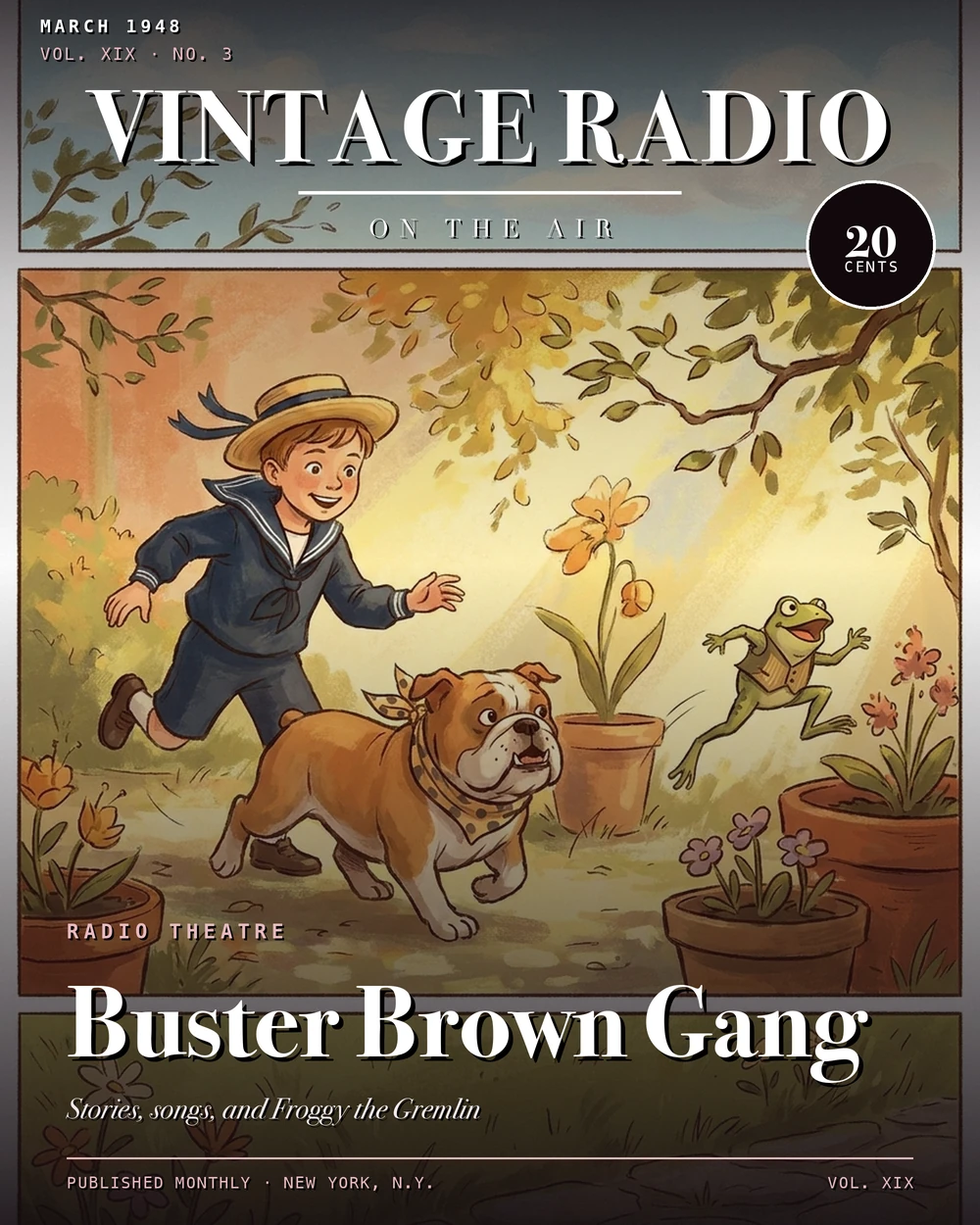
Buster Brown Gang
The Man Behind the Microphone
The thing that made the Buster Brown Gang work wasn't the sponsor, the characters, or even Froggy the Gremlin — it was Smilin' Ed McConnell, a jovial, gravel-voiced man who topped 250 pounds and liked to joke about it. McConnell had been on the air since May 30, 1922, racking up fifteen years of radio experience before the Buster Brown show ever launched. He was the son of an itinerant Georgia preacher, and before radio found him, he'd worked as a dishwasher, done time as a small-time prizefighter, toured vaudeville and the Chautauqua circuit, and served in World War I — where, according to an NBC press release, he was briefly pronounced dead after a troop train wrecked in Arkansas and had to be revived by a buddy with artificial respiration.
His entry into radio was accidental. In 1922, a scheduled performer failed to show up at an Atlanta station, and McConnell stepped in. He was a natural. Broadcasting on WSB Atlanta starting at 10:45 at night, he sang light ballads, played piano, and spun homespun philosophy until he felt like stopping — sometimes running until three or four in the morning. WSB's clear-channel signal reached all across the eastern United States, and baskets of telegrams arrived throughout the night from listeners who'd caught him from hundreds of miles away. "I started at 10:45 p.m., and quit when I felt like it," he said of those early sessions.
By 1932 he had his first network date — a quarter-hour CBS run for Acme Paints starting September 20 of that year. Acme stayed with him as a loyal sponsor through 1940, and during those years McConnell moved across CBS, NBC, and the Blue Network in various timeslots. A 1937 NBC slot billed him as the Sunshine Melody Man, singing hymns accompanied by pianist Irma Glen. He also ran a concurrent show packaged for the American Poultry Journal, distributed to over fifty stations on transcription discs. Variety caught one of his Purity Baking Company programs and noted that McConnell "mines the rich veins of American sentiment among those who are white-haired, churchgoing, rural and simple" — which was both a mild dig and an accurate description of his appeal.
How the Buster Brown Gang Came Together
The Buster Brown character had existed on radio before McConnell ever touched it. R. F. Outcault created Buster Brown as a comic strip character in 1902, and the Brown Shoe Company had purchased the rights at the 1904 St. Louis World's Fair. An early CBS series ran fifteen-minute dramas on Friday evenings in 1929–30, featuring Buster as "the boy who lives in a shoe" alongside his dog Tige. A second season moved to the Blue Network under the title Buster Brown and His Dog Tige, and then the character went dormant on radio for over a decade.
The 1944 revival brought McConnell in as the central figure, and the show that resulted was substantially different from the earlier straight drama format. Buster Brown Gang premiered on NBC on September 2, 1944, airing Saturdays at 11:30 a.m. for thirty minutes with Buster Brown Shoes as its sole sponsor throughout the entire NBC run. The Brown Shoe Company eventually committed its entire advertising budget to the show and the associated comic book giveaways — and reportedly watched annual sales climb from eight million dollars to thirty million dollars over McConnell's twelve-year association with the brand.
Holding things together in the production booth were producers Frank Ferrin and Hobart Donovan, with Archie Presby as announcer and John Duffy and Ken Cameron handling organ and piano. Sound effects came from Bud Tollefson, Jack Robinson, and Virgil Reimer. The dramatized adventure segments — stories of frontier life, jungle treks, Robin Hood — ran as quarter-hour pieces within the half-hour show and featured a solid roster of Hollywood radio actors: Lou Merrill, June Foray, Joe Fields, Ken Christy, Wendell Noble, Tommy Cook, Conrad Binyon, Lou Krugman, John Dehner, and others.
Froggy, Midnight, and the Gang
The show's imaginary cast was invented entirely for the radio version — none of these characters appeared in Outcault's original comic strip. McConnell voiced all of them himself: Squeeky the Mouse, Midnight the Cat, Grandie the Piano, and Froggy the Gremlin. A signature production quirk ran through every broadcast: McConnell plunked the piano on every word he wanted to emphasize, giving the show a distinctive rhythmic texture unlike anything else on the air.
Froggy was the undisputed star. Portrayed as an invisible imp who could be summoned through his "magic twanger," Froggy's whole comic routine was built around torturing pompous guest characters — "Algernon Archibald Percival Sharpfellow, the Poet," "Jim Nasium, the athletic instructor," "Alkalai Pete, the cowboy." These guests were reliably long-winded and self-important, which made them perfect targets. Froggy's pranks worked by a kind of hypnotic suggestion: a guest would announce what he was about to do, and Froggy would insert a ludicrous alternative that the guest would then helplessly carry out before snapping back to reality and fleeing the stage in fury. The young studio audience loved it. Froggy's speech pattern involved doubling his own phrases — "Now I'll sing my song, I will, I will" — and McConnell voiced him in a low, gruff croak. For the radio duets between McConnell and Froggy, announcer Archie Presby took over the Gremlin's voice. Presby also physically dressed in frog costume and leapt out from behind a curtain whenever McConnell called for Froggy in front of the studio audience.
June Foray, who voiced Midnight the Cat and Grandie the Piano on the show from 1944 to 1952, met producer Hobart Donovan on the program — Donovan was also the primary writer of the Buster Brown comic books distributed free at shoe stores. Foray and Donovan married in 1955 and remained together until his death in 1976. Jerry Maren, born Gerard Marenghi, played Buster Brown — the human character who tied the show to its sponsor — in costume complete with Victorian short pants and a curled wig. Maren is better known today as the green-garbed center member of the Lollipop Guild in the 1939 film The Wizard of Oz; he lived to age 98.
The other half of each broadcast, outside the dramatic serial, had McConnell reading letters from young fans — often submitted as "Brown Jug Jingles" — and chatting with his imaginary cast. The show opened with McConnell's Buster Brown song ("I got shoes — You got shoes — Why, everybody's got to have shoes!") and closed with the final thump of Grandie the Piano.
The Sponsor's Long Reach
The Buster Brown connection ran deeper than a single on-air mention per broadcast. The Brown Shoe Company, headquartered in St. Louis, distributed free Buster Brown comic books at shoe stores — eventually expanding them to include adventure stories featuring McConnell and the gang alongside Midnight, Squeeky, and Froggy. McConnell told young listeners they could pick up a comic book at a local store without making a purchase. Producer Hobart Donovan wrote the comic books as well as producing the radio show, which kept the two properties tightly connected.
Premiums extended further still. The show offered a Buster Brown Gang neckerchief, games, trinkets, and records of McConnell's novelty songs. By 1948, Rempel Manufacturing of Akron, Ohio, was producing a Froggy the Gremlin rubber squeaker toy in five-inch and nine-inch versions, embossed "J. Ed McConnell, Pats. Pend. 1948." The toy's cultural reach was confirmed when it appeared in an episode of I Love Lucy. Buster Brown shoe stores also featured three-dimensional motorized in-store display units — wooden stages roughly five feet by three feet — showcasing the gang's characters. The show's rights, including all its characters, were owned personally by McConnell; at his death they passed to his estate and his two children, Mary Jane and Jimmy.
From Radio to Television
The show made the jump to television in 1950, running on NBC initially and then shifting to CBS from August 1951 to April 1953, before moving to ABC through April 1955. The TV set resembled a clubhouse, with McConnell seated in a large easy chair opening a big book called "Smilin' Ed's Stories" from which filmed adventure segments played. The most frequently featured serial followed Ghanga Rama (also rendered as Gunga Ram), an elephant boy played by Nino Marcel, set in the fictional Indian village of Bakore.
On television, Froggy became a hand-operated rubber puppet — a small green frog-like figure in a red jacket, white shirt, and bow tie, conspicuously missing trousers. He was summoned by the catchphrase "Plunk yer magic twanger, Froggy!" and appeared in a puff of smoke greeting the audience with "Hiya kids, hiya hiya!" The Squeeky the Mouse puppet, it turned out, was actually a hamster. As McConnell's health deteriorated during the television run, the production shifted from a live studio audience to prefilmed reaction shots of children cut into the studio performance.
McConnell died on July 23, 1954, aboard his boat at Newport Beach, California, of a heart attack. He was 6 feet tall and had weighed over 250 pounds at the height of his career. After the network aired a season of reruns, Andy Devine — who had previously played Jingles on The Adventures of Wild Bill Hickok — took over the franchise. The retooled show, called Andy's Gang, ran on NBC from August 20, 1955, to December 31, 1960. Devine worked without a live studio audience, using prefilmed reaction shots, and the big book was renamed "Andy's Stories." Much of the McConnell-era footage was repurposed by editing in Devine's host segments. The full Andy's Gang cast included Nino Marcel continuing as Gunga Ram, June Foray returning as Midnight the Cat, Alan Reed as the Poet, and Jerry Maren continuing as Buster Brown. The entire film inventory — described as over a ton of material — along with the broadcast rights eventually became the property of Hubbard Broadcasting of St. Paul, Minnesota. Some programs from the Andy Devine era survive, including a few segments filmed in color near the end of the run in 1960.
Froggy the Gremlin outlasted both McConnell and the Buster Brown franchise in cultural memory. The 1982 Buckner & Garcia album Pac-Man Fever included a track called "Froggy's Lament" recalling the character, and in 2006, the book Before You Leap, written in the voice of Kermit the Frog, paid tribute to Froggy as "one of the only on-screen amphibian stars." McConnell himself was honored with a star on the Hollywood Walk of Fame, dedicated on February 8, 1960, at 6650 Hollywood Boulevard.